Senior User Experience Designer and Accessibility Expert
I'm a UX specialist, and I love improving systems and simplifying the complex.
AI-hackathon pre-sales to product pipeline
Won first place in our organizational AI hackathon, product team group. Adopted by the sales team post-event.
Problem statement:
Every prospect engagement cost Glasswall's Solutions Architects 30 to 60 minutes of manual work, custom diagrams, repeated answers, and inconsistent responses. The pre-sales workflow was a bottleneck with no shared system and no way to scale.
My role:
One of four contributors on a cross-functional hackathon team. My focus was UX design, translating five distinct operational problems into a single, coherent interface that Solutions Architects could rely on during live prospect conversations. In a hackathon measured in hours, the design had to be right the first time.
Users and goals:
-
Solutions Architects (primary): respond to prospect questions quickly, accurately, and consistently without rebuilding answers from scratch
-
Sales team (secondary): handle more technical inquiries independently, without waiting on SA availability
-
Prospects and customers: receive professional, editable diagrams and clear technical responses that they could act on
Defining the problem:
Five distinct pain points were identified, each a specific, solvable failure in the existing workflow:
-
Inconsistent responses: technical answers varied in accuracy depending on who was responding
-
Diagram bottleneck: custom integration diagrams took 30 to 60 minutes of manual effort per prospect
-
Partner knowledge gaps: no repeatable process for validating integration feasibility
-
Repetitive question fatigue: the same 7 to 10 prospect questions answered from scratch, every time
-
Diagram lock-in: outputs couldn't be edited by customers or sales teams after delivery
The Solution:
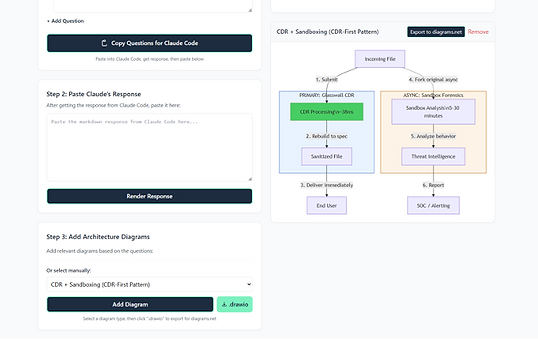
A single-page browser application with no backend, no installation, and no barrier to adoption.
Two purpose-built AI agents addressed the identified problems directly:
-
glasswall-presales-responder: eliminated inconsistent responses and question fatigue with verified product specs, honesty rules to prevent over-claiming, and seven one-click response templates for the most common prospect questions
-
partner-integration-architect: researched partner integrations, assessed feasibility, and generated "better together" value propositions with built-in accuracy validation
Five pre-built architecture diagram templates covering NAS Polling, Sandbox Integration, M365 Email Protection, Web Proxy, and REST API Direct solved the diagram bottleneck directly. Rendered in real time via Mermaid.js and exported as fully editable draw.io XML, they were customer-ready the moment they were generated.
Design under constraint:
-
The UX had to be invisible, an interface a Solutions Architect could navigate without thinking, even with a prospect on the phone.
-
Every interaction reduced to its simplest form: one-click generation, immediate output, no configuration required
-
The single-file architecture eliminated every possible point of friction between the tool and the user
-
draw.io export was designed in from the start, not added later
-
The hackathon time constraint enforced focus, and every feature had to justify its presence, resulting in a tool with no unnecessary surface area
Outcome & impact
-
First place in the hackathon, recognized for practical value and quality of execution
-
Presented to company leadership as a model for AI-augmented pre-sales capacity
-
Adopted by the sales team post-event, moving from prototype to active daily use
-
Cut prospect response time from 30-plus minutes to under 2 minutes
-
Freed Solutions Architects from repetitive work, enabling the sales team to handle more technical inquiries independently
Reflection:
Clarity of problem definition is the most valuable input a design process can have. Five precisely identified pain points gave the team a shared target, and the time constraint enforced the focus needed to hit it.
Designing for a tool used inside high-pressure sales conversations sharpened what "intuitive" actually means, not simple, but that the complexity is handled by the system, not the user. A prototype adopted into real daily use is the clearest signal that the problem was understood and the solution was right.