Senior User Experience Designer and Accessibility Expert
I'm a full-stack UX specialist, and I love improving systems and simplifying the complex.
AI-hackathon pre-sales to product pipeline
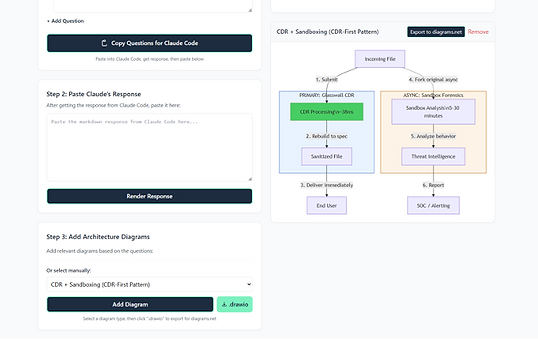
Won first place in our organizational AI-hackathon in the product team group, using Claude Code to create a web-based tool in a limited time, adopted by the sales team
Problem statement:
Every prospect engagement cost Glasswall’s Solutions Architects 30 to 60 minutes of manual work — custom diagrams, repeated answers, inconsistent responses. There was no shared system, no scalable process, and no way to keep up. The pre-sales workflow was a bottleneck, and the sales team was feeling it.
My role:
One of four contributors on a cross-functional hackathon team, each bringing complementary skills to the table. My focus was UX design — responsible for translating five distinct operational problems into a single, coherent interface that Solutions Architects could rely on under the pressure of live prospect conversations. In a hackathon measured in hours, there is no room for iteration. The design had to be right the first time.
Users and goals:
-
Solutions Architects (primary): needed to respond to prospect questions quickly, accurately, and consistently — without rebuilding answers from scratch every time
-
Sales team (secondary): needed to handle more technical inquiries independently, without waiting on SA availability
-
Prospects and customers: needed professional, editable diagrams and clear technical responses they could take away and act on
The tool had to be fast to use, trustworthy in its output, and polished enough to put directly in front of a customer.
Defining the problem:
Before a single screen was designed, the team mapped the problem space precisely. Five distinct pain points were identified — each one a specific, solvable failure in the existing pre-sales workflow:
-
Inconsistent responses: technical answers to prospects varied in accuracy and completeness depending on who was responding and what they remembered
-
Diagram bottleneck: creating custom integration diagrams for each prospect took 30–60 minutes of manual effort — time that simply wasn’t available at scale
-
Partner knowledge gaps: validating integration feasibility with technology partners quickly and reliably had no repeatable process
-
Repetitive question fatigue: the same 7–10 prospect questions were being answered from scratch, every time, by every SA
-
Diagram lock-in: outputs couldn’t be edited by customers or sales teams after delivery, limiting their usefulness downstream
This problem definition was the foundation everything else was built on. Clear problems made for clear solutions.
The Execution:
With the problem space defined, the team moved fast and deliberately. The decision was made early to build a single-page browser application — no backend, no installation, zero barrier to adoption. Every technical and design choice that followed served that constraint.
The core of the solution was two purpose-built Claude Code AI agents, each engineered to address a specific cluster of the identified problems:
-
glasswall-presales-responder: built to eliminate inconsistent responses and question fatigue. Armed with verified product specifications, honesty rules to prevent capability over-claiming, and consistent formatting, every prospect interaction now starts from the same reliable foundation. Seven one-click response templates put the most common questions one step away from a polished answer
-
partner-integration-architect: built to close knowledge gaps and accelerate diagram creation. The agent researched partner integrations, assessed feasibility, and generated “better together” value propositions with built-in accuracy validation — replacing hours of research with seconds
Five pre-built architecture diagram templates — covering NAS Polling, Sandbox Integration, M365 Email Protection, Web Proxy, and REST API Direct — solved the diagram bottleneck directly. Rendered in real time via Mermaid.js and exported as fully editable draw.io XML, they were customer-ready the moment they were generated.
Design under constraint:
-
Designing a tool in hours that would be used in high-stakes sales conversations required a specific kind of discipline. The UX had to be invisible — an interface that a Solutions Architect could navigate without thinking, even with a prospect on the phone.
-
-
Every interaction was reduced to its simplest form — one-click generation, immediate output, no configuration required
-
Tailwind CSS enabled rapid, consistent visual design without sacrificing quality for speed
-
The single-file architecture wasn’t just a technical choice — it was a UX choice, eliminating every possible point of friction between the tool and the user
-
draw.io export was designed in from the start, not added later — because a diagram that can’t be customized by the customer isn’t truly useful
The constraint of the hackathon format was, paradoxically, a design advantage. With no time for scope creep, every feature had to justify its presence. The result was a tool with no unnecessary surface area — lean, purposeful, and immediately useful.
Outcome & impact
-
Placed in the hackathon — recognized for practical value and quality of execution against competing teams
-
Presented to company leadership as a credible model for AI-augmented pre-sales capacity
-
Adopted by the sales team post-event — moving from hackathon prototype to active daily use
-
Cut prospect response time from 30+ minutes to under 2 minutes
-
Freed Solutions Architects from repetitive work, enabling the sales team to handle more technical inquiries independently
-
Delivered consistent, verified, professionally formatted responses and diagrams across every prospect interaction
Reflection:
This project demonstrated something that longer engagements can obscure: clarity of problem definition is the most valuable input a design process can have. Five precisely identified pain points gave the team a shared target, and the time constraint enforced the focus needed to hit it. There was no room for ambiguity, and that produced better outcomes than more time might have.
Designing for a tool that lives inside a high-pressure sales conversation sharpened my understanding of what “intuitive” actually means. It doesn’t mean simple — it means that the complexity is handled by the system, not the user. That principle drove every design decision made here.
A hackathon prototype adopted into real daily use by the sales team is the clearest possible signal that the problem was understood and the solution was right.